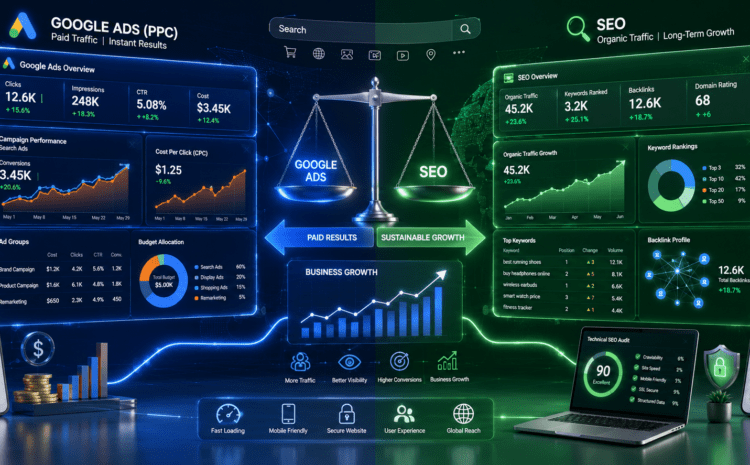
Google Ads vs. SEO: Which Wins on ROI in 2025?
Should I put money into Google Ads, or should I focus on SEO?” We hear this constantly at Softcrust Digital Experts probably more than any other question, honestly. It makes sense because around 63% of businesses struggle to decide between paid advertising and organic search. Choosing between the two isn’t always straightforward, especially when comparing the long-term value of Google Ads vs. SEO. The truth is, neither strategy is inherently better. They simply deliver results on different timelines and serve different business objectives.
We’ve managed over $2 million in Google Ads spend, and we’ve also helped clients achieve remarkable organic growth, including increasing one client’s search traffic by 1,253%. Here’s what that experience has taught us: both strategies work when they’re aligned with the right goals. Which one delivers the strongest ROI for your business depends on your budget, growth objectives, competition, and how quickly you need results. This guide breaks down the real costs, timelines, and performance of each approach so you can make a confident, data-driven decision instead of relying on guesswork.
Where Things Stand Right Now
Google still owns search. Roughly 92% of it, worldwide. Bing and Yahoo split whatever’s left. Close to 59% of searches happen on a phone now too, and that’s quietly changed how both ads and organic content get built these days.
On spending, businesses put around $79 billion into SEO globally last year. Google Ads pulled in nearly $279 billion. Most companies split their budget close to 40% ads, 35% SEO, the rest elsewhere. Which says something a lot of businesses aren’t picking a lane at all. They’re hedging.
What Google Ads Actually Involves
It’s pay-per-click. Bid on keywords, your ad shows up, you pay when someone clicks. Simple to explain. Running it well takes real, constant attention though.
Returns vary a lot by industry generally somewhere in the 200-800% range. E-commerce tends to land around 400-600%, professional services closer to 300-500%, SaaS can climb toward 700%. Conversion rates on search ads average about 3.75%. Cost per click could be a dollar or fifty, depends entirely on your field.
What makes it appealing is speed, first and foremost. Launch today, see traffic today. Nothing else really competes with that. Targeting’s sharp too age, location, past visitors, browsing habits. And you stay in control the whole time: pause it, tweak the copy, test something new, adjust bids on a whim. Every dollar gets tracked, so there’s no real mystery in what’s working.
But it costs you forever. Stop paying and the traffic stops right along with it. Nothing sticks around underneath it. Prices climb as competition grows, and click fraud is a real problem bots, rival clicks, accidental taps, chewing through 10-20% of your budget sometimes. And about a quarter of users won’t click an ad no matter what you do. Younger crowds especially scroll right past them.
What SEO Actually Involves
SEO means shaping your site so it climbs the rankings organically, over time. Technical work, content, link building slower, sure, but it doesn’t disappear the moment you stop paying attention.
Long-term, returns often beat ads outright sometimes 500-1500%. Organic conversion rates average around 14.6%. Cost per acquisition runs about 60% cheaper than paid ads. The catch is time. Plan on 3-6 months minimum before you see much movement. Year one usually brings 100-300% ROI. By year three, that can climb past 800% once things really start compounding.
What SEO gives you that ads never will is staying power. Rankings compound. An old blog post can keep pulling traffic years later without you touching it again. Authority builds quietly in the background the whole time. About 70% of people say they trust organic results more than ads, and that shows up in stronger click-through rates. No per-click fee either, so it scales without your costs climbing alongside your traffic.
The downside is nothing’s guaranteed. One algorithm update can shuffle your rankings overnight. It needs ongoing content, technical upkeep, steady link work. Not something you set up once and walk away from.
Head to Head
Speed goes to Google Ads, easily hours versus months. Cost depends on your timeline: ads usually run $1,000-$10,000+ monthly, ongoing, while SEO tends to need $2,000-$5,000 monthly upfront. Long-term ROI goes to SEO, since it just keeps compounding instead of stopping cold the second you cut the budget. Ads win on precision and measurability. SEO wins on trust people simply believe organic results more than something stamped “Ad.”
Two Quick Examples
Picture a local law firm spending $5,000 a month on ads. Average $25 per click, 200 clicks, 5% conversion that’s 10 new clients. Worth $3,000 each, that’s $30,000 in revenue against $5,000 spent. Roughly 500% ROI.
Now picture an e-commerce store putting $3,000 a month into SEO instead. A year later, they’re pulling 10,000 organic visitors monthly, converting at 2%, so 200 orders. At $150 average order value, that’s $30,000 in revenue against just $3,000 spent closer to 900% ROI. Same $30k outcome, two completely different roads there.
Which Should You Actually Pick?
Pick Google Ads if you need results now, not eventually. New launch, seasonal push, product debut, or you’re competing somewhere brutal like legal or real estate, where waiting six months isn’t realistic. Works best with real budget behind it too, ideally $1,000+ monthly so you’ve got room to actually test things out.
Pick SEO if you’re building for later. Brand authority, a content-heavy business like e-commerce with a big catalog, or you’re a startup that can’t keep funding ad spend month after month. It’s also the better fit for trust-heavy fields, healthcare and finance especially, where people want to feel like they found you rather than were sold to.
Or Just Do Both
Honestly, most businesses do best combining the two. Ads hand you keyword data you can feed straight into your SEO plan, and running both means owning paid and organic space on the same results page at once. A decent hybrid approach usually looks like this: lean on ads early for quick wins, use what you’re learning to shape your SEO foundation over the following months, then slowly pull ad spend off keywords that are now ranking organically and shift that money toward new ground instead.
Smaller businesses, spending $2,000-$5,000 monthly, tend to lean 60/40 toward SEO. Growing businesses around $5,000-$15,000 often split closer to even. Bigger, established companies spending $15,000+ tend to flip that around, going 60% ads and 40% SEO, since they can push hard on both fronts at once.
Ready to figure out which approach actually fits your business?
Frequently Asked Questions
Which gets results faster Google Ads or SEO?
Google Ads, easily. Traffic can start within hours. SEO usually takes 3-6 months before rankings actually start moving.
Is running both a waste of money?
Not really. Businesses that blend the two often see 30-50% higher returns compared to sticking with just one channel.
What should a small business budget for either one?
Somewhere between $2,000 and $5,000 monthly is a reasonable starting point for either, though tighter budgets usually lean more toward SEO.
Final Thoughts
There’s no real winner here between Google Ads and SEO. It’s about matching the strategy to wherever your business actually stands right now. Ads get you seen fast with sharp targeting. SEO builds something that keeps working long after you’ve moved on to other things. Most businesses in 2025 end up doing a bit of both — ads for quick wins, organic authority building quietly underneath. Softcrust Digital Experts has helped clients hit an average 5x ROI blending both strategically reach out for a free strategy consultation if you want help figuring out your own mix.